Will the 'Technocratic' Palestinian Committee Now Governing Gaza Support Trump's Peace Plan?
Recent remarks from its new chairman Dr. Ali Shaath raise questions about the panel's apolitical nature -- and ambitions

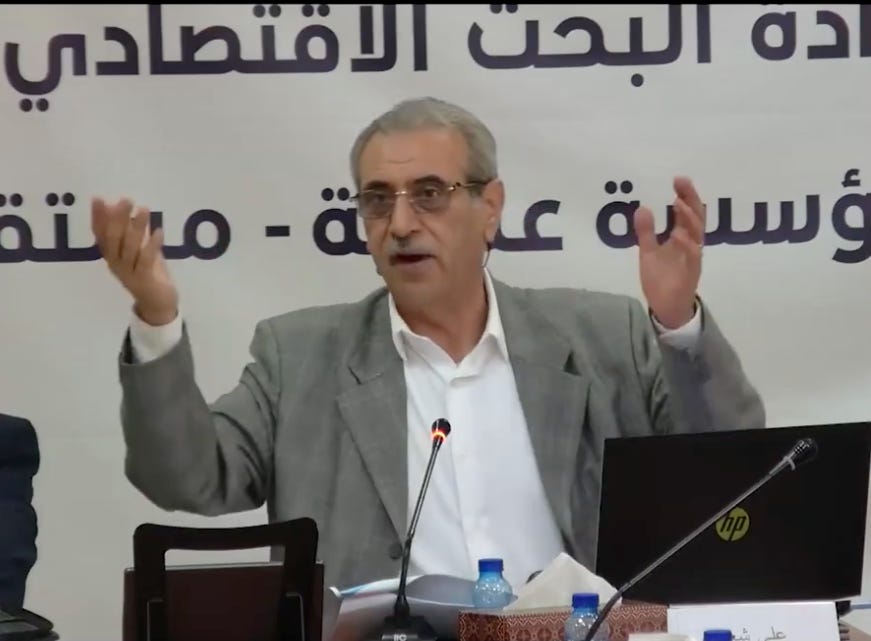
Is the “technocratic” Palestinian committee now responsible for administering Gaza going to work for, or against President Donald Trump and his plans for the Strip, Israel, and peace in the Middle East?
The views of that 15-member committee’s newly installed leader, Dr. Ali Shaath, suggest a potential conflict.
Shaath has been framed in reporting as an apolitical actor – a civil engineer and former longtime Palestinian Authority bureaucrat, with extensive experience in high-level positions touching on practical concerns like economic development, housing, and transportation.
Set aside that serving in the Fatah-led Palestinian Authority suggests some level of ideological orientation, given it supports policies like “pay-for-slay” that reward jihad, indoctrinates its constituents with educational materials and media promoting Islamic supremacism and genocidal Jew-hatred, and consists of numerous members who have faced U.S. sanctions.
The committee head’s own recent statements, which appear to have gone unreported, indicate he is more than a technocrat, but someone with an ideology and vision.
Just over two months before the announcement of his elevation to chairman of the National Committee for the Administration of Gaza, Shaath spoke on a panel before the Doha-based Center for Conflict and Humanitarian Studies titled “Charting Gaza’s Long-term Future: Beyond the Trump and Blair plans.”
There, according to the translation provided by the center, Shaath linked the rebuilding of Gaza to grander ambitions, namely including Palestinian statehood, and the throwing off the yoke of purported Israeli control.
“We need a new vision as Palestinian people to transfer the destruction of the war to [a] resilient environment that will lead to liberty from the Israeli occupation and to Palestinian sovereignty on Palestinian lands in the West Bank, Gaza Strip, and Jerusalem,” he argued.
Seeming to reject an international role in post-war plans, Shaath added that “This is a stage of self-determination and not only a relief journey…We don’t need to be only people that [are] subject to international sovereignty. We need to be subjects and led by Palestinian Authority towards liberty…”
Whether Shaath’s version of “liberty” looks like ours, and whether he supports a Palestinian Authority that would recant its core Islamist and anti-Semitic beliefs and associated policies – its contemplated reform being part of the Trump administration’s 20-point plan – is yet to be seen.
Perhaps more significant is Shaath’s explicit admission of an aversion to President Trump’s designs.
“We need to launch the reconstruction piece on political reconciliation,” the committee chairman said, “to achieve economic and political plans as opposed to the Trump and Blair plans to not be under the Occupation one way or another, and to guarantee the reconstruction project of a Palestinian state.” [Emphasis mine]
Further making clear his antipathy towards Israel, and his adamant position that there be a Palestinian state to include the Jewish state’s capital of Jerusalem, Shaath asserted:
I speak as one who lost his home under brutal genocide. We need to be realistic and to save our people without affecting our sovereignty and to establish Palestinian state. The West Bank cannot be separated from Jerusalem or Gaza. We are one people and one nation with Gaza, West Bank, and Jerusalem, and we need to be [a] cohesive nation. The reconstruction is economic, political, social, administration – it’s a comprehensive reconstruction and we reject to have imposed…through the Israeli forces.
The panel’s moderator did not explicitly ask the committee chairman about his views on the likes of Hamas, Palestinian Islamic jihad, and other terrorist groups, and their future in Gaza and beyond. But Shaath did say this: “International law gives the right to any people that live under the Occupation to resist that occupation.”
His comments from months earlier may provide further clarity. In January 2025, Shaath spoke at a symposium at the Annual Palestine Forum in Doha titled “The Genocidal Israeli War on Gaza: Scenarios for the Day After.”
There, according to the event’s translator, he said: “We don’t have the right to prevent those who opt for Hamas or jihad to be an integral part of the Palestinian people. No one has a right to prevent these factions [from] participat[ing] in ruling their country.”
Shaath is not alone among committee members to have served in the Palestinian Authority. Perhaps in a future post I will scrutinize some of their remarks and activities.
Israel’s official position is that it can tolerate those tabbed to the panel. And the still-to-be-named Board of Peace, led by President Trump, will oversee the “technocratic” committee’s activities.
But that the committee’s members are supported too by Hamas and Fatah should give us pause.
As should one of Dr. Shaath’s first public comments, subsequent to his appointment, wherein he took to Palestinian radio speaking of plans to expand Gaza: “If I bring bulldozers and push the rubble into the sea, and make new islands, new land,” he proclaimed, “I can win new land for Gaza and at the same time clear the rubble.”
Time will tell whether and to what extent the ostensibly technocratic committee confines itself to clearing debris and pouring concrete in a tunnel-free, jihadist-vacated, de-Nazified Gaza Strip, and otherwise advancing the goals set forth by the Trump administration, or instead undermines them.