U.S.-Iran Memorandum of Understanding: From Tactical Victory to Strategic Defeat?
Did the U.S. achieve tactical victories, only to suffer strategic defeat?

Will the war with the Islamic Republic of Iran have resulted in stunning tactical victories, but ultimately a strategic stalemate if not defeat?
The 14-point U.S.-Iran Memorandum of Understanding (MOU) meant to end current hostilities, and stave off future chaos, bloodshed, and nuclear war for America and our allies begs that question.
Below is my analysis of the pact by way of a series of queries pertaining to its main points — followed by concluding remarks on the war and desired peace.
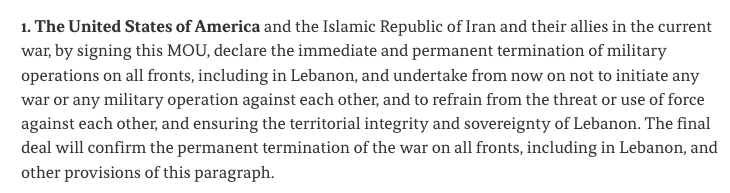
Why would the U.S. agree to “permanent termination” of war against a regime that has been at war with us since its inception 47 years ago, has the blood of thousands of Americans on its hands, and is the world’s leading state sponsor of jihad? The regime has not renounced its ideology. Nor has it made any shows of good faith that we are aware of outside of the MOU to demonstrate that it has given up on its desire to dominate the world and fulfill its Twelver Shia apocalyptic vision. If it remains bellicose, why would we commit not to combat it in the future? Why not just declare a temporary cessation of hostilities while trying to work out a (longshot) diplomatic resolution?
Separately, did the U.S. pledge Israel to the MOU with respect to ending military operations in Lebanon against Hezbollah? Israel is not a signatory to the document. Its people were forced by the tens of thousands out of the north due to the rockets raining down from Iran-backed Hezbollah after Iran-backed Hamas inflicted the October 7th massacre. The Hezbollah threat persists. No country would tolerate it. Lebanon’s leaders have proven unable or unwilling to neutralize the Iranian proxy that dominates the country. There has been no sign that Iran is willing to pressure the group to stand down, let alone force it into exile and cut ties with it altogether.
Moreover, why did the U.S. allow Iran to link Lebanon/Hezbollah to any such deal? Doing so validates its proxy strategy and knowingly invites potential friction between the U.S. and Israel. It suggests to Iran that it can get the U.S. to restrain Israel — removing a key impediment to the mullocracy’s murderous machinations.

Under the MOU will Iran shut down its ongoing influence operations? Will it cease its information warfare and cyber warfare efforts? Will it order its terrorist cells home? Again, we have not seen any action suggesting Iran’s commitment to peaceful relations with the U.S. We have however seen in the past that it will pocket concessions and at best bide its time and maintain its malign activities surreptitiously and perhaps at a slower cadence until conditions are more propitious for it to re-engage in overt hostile acts.
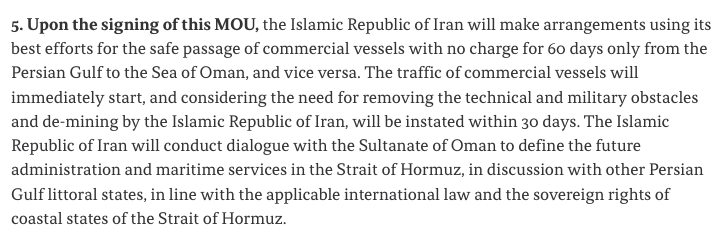
Under the MOU is Iran only pledging to keep the Strait of Hormuz toll-free for 60 days? What about thereafter? And why is there no language prohibiting the seizure of the Strait of Hormuz going forward? Even if there was such language of course, there does not appear to be any enforcement mechanism baked into the MOU. We will just have to take Iran’s word for it, it seems. That the U.S. would use all levers of power, including force, to break a future chokepoint maneuver, seems to only be a threat extant outside the document. And any momentum towards a final deal, not to mention midterm elections and other domestic and foreign considerations may deter the U.S. from acting should Iran test us.
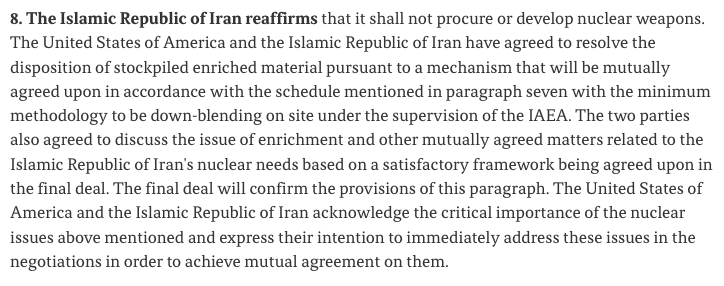
To “reaffirm” its commitment not to “procure or develop nuclear weapons” Iran would’ve had to affirm such a commitment in the first place. When did it ever do that? The purported fatwa against nuclear weapons was of course a farce. Iran never had any need for highly enriched uranium other than for a bomb. The evidence of Iran’s pursuit of a nuclear weapon — despite regime protestations to the contrary — over the decades has been overwhelming. And the whole purpose of destroying Iran’s nuclear capability was to prevent it from getting such a weapon.
Is “down-blending on site under the supervision of the IAEA” not in and of itself a U.S. concession, to say nothing of punting issues of enrichment, presumably inspection and verification regime, etc. till future negotiations? And why does a nation as oil-rich as Iran have need for any nuclear infrastructure? After all, it is implied here that such capabilities are negotiable when talking of “Iran’s nuclear needs.”

Does maintenance of the “status quo” include permitting freedom of navigation in the Strait of Hormuz? Ceasing the production of ballistic missiles? Severing all support for terrorist proxies? Prohibiting operations targeting U.S. government leaders, Jewish individuals and institutions, members of the Iranian diaspora, and every other cohort and nation that the regime has historically threatened abroad? Freeing political prisoners, and ending the practices of taking, torturing, and murdering them? If not, the “status quo” would appear to be nothing more than a paper commitment for Iran not to produce and procure nuclear weapons in exchange for hundreds of billions of dollars in unfrozen funds, sanctions relief, and new investment.
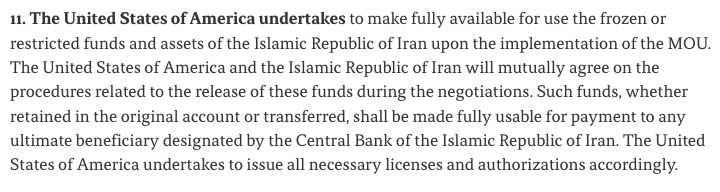
When is the MOU defined as “implemented?” Under one reading of this document, Iran would appear to get unfrozen billions of dollars in funds before committing to anything other than reopening the Strait of Hormuz (perhaps temporarily), and a written commitment to no nuclear weapons. The MOU also does not explicitly prohibit Iran from flowing those funds to forces hostile to the U.S., our allies, and partners.

Will the MOU or any future Iran deal ultimately be subject to the Iran Nuclear Agreement Review Act (INARA)? There’s a compelling case to be made that any Iran nuclear deal should have to go to the Senate as a treaty, but there has not been any talk of such a process at this point.
Two additional questions result from the document:
Why does the U.S. seem to commit to giving Iran nearly all the benefits of the MOU, in exchange for almost zero tangible Iranian concessions, if the regime’s conventional strength has been eviscerated, and its new leaders are supposedly ready to make peace?
And does the MOU not reward the mullocracy for and prove the merits of its strategy of pursuing nuclear weapons, seizing chokepoints like the Strait of Hormuz, and siccing proxies like Hezbollah on its foes to survive, if not recapitalize and ultimately thrive?
Let me conclude by stating this: Whether in crippling the mullocracy’s nuclear infrastructure, destroying its conventional military capabilities, or decapitating its leadership, America, working in concert with Israel, undeniably landed major blows that will have set back the regime’s malign efforts for years. It was a righteous effort. It was a courageous effort. And it no doubt will have sowed fear and doubt in the minds of our adversaries.
But, as I have cautioned throughout the conflict, it is hard to see how America can achieve the president’s stated objectives on a permanent basis if the mullocracy survives.
That is because Iran’s ruling regime, as noted, is guided by a Shia Twelver ideology that is theocratic, imperialistic, and apocalyptic. All of the mullocracy’s most malign efforts, be it in developing nuclear weapons, launching ballistic missile barrages, fostering and fomenting terror proxies, or closing off vital chokepoints to inflict maximum economic pain, flow naturally from the regime’s ideology.
A durable and decisive victory then could only be ensured if the regime were to surrender, collapse, or be overthrown and replaced by a non-hostile government.
Perhaps President Trump believed that the U.S.-Israeli operation would lead to the mullocracy’s fall.
Perhaps, in the face of the growing economic pain and domestic and foreign pressures to end the war, he calculated that the cost-benefit analysis weighed against doing whatever was necessary to crush the regime.
Perhaps he felt buying time via the Memorandum of Understanding was the best of a series of suboptimal options; that Iran may well blow up an extremely generous deal, undermining its position; that internal chaos could ensue should it not get needed sanctions relief while the Strait of Hormuz stood de-mined and re-opened; that the president’s operational freedom might increase; and that the conditions for the U.S. to win the war might therefore prove better in the future.
Or perhaps he believed that having suffered losses of such great size, the mullocracy would genuinely set its ideology aside and play ball.
Whatever the case, the proposition that Iran’s regime, having suffered a near-death experience, has been transformed, will now be tested.