In Landmark Racial Gerrymander Case, Justice Thomas Calls on SCOTUS to Leave Districting Fights to Lawmakers, Not Radicals in Robes
Beyond rolling back racial gerrymanders, Thomas wants the Court to jettison the fundamentally corrupted jurisprudence that has spawned such racialist practices

.jpg)
Don’t Overlook Justice Clarence Thomas’ Concurrence In Racial Gerrymandering Case
In Louisiana v. Callais, the Supreme Court struck a major blow against race-based policymaking, holding that the law protects voters from discrimination, rather than mandating that states create racial gerrymanders as an ostensible corrective to discrimination. The decision builds on a string of cases whereby the Roberts Court has distinguished itself by rightly opposing present “anti-racism” as a remedy for past racism — with potentially massive political implications.
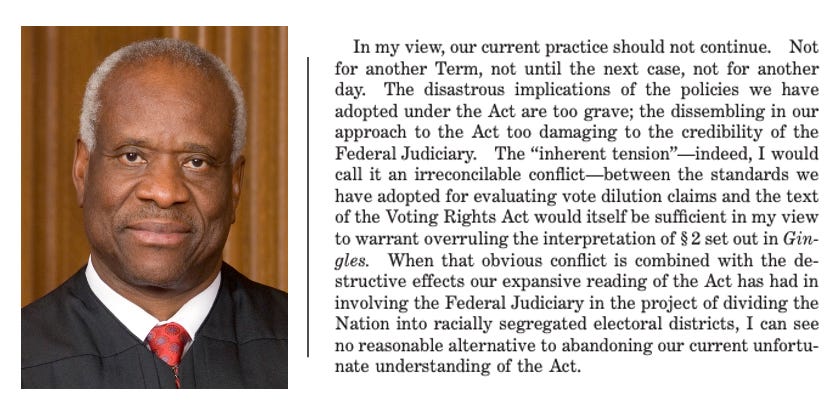
Yet as righteous and monumental as Louisiana v. Callais may be, it modifies legal precedent. It does not jettison it. And in a terse but provocative two-page concurrence, Justice Clarence Thomas, hearkening back to an underappreciated opinion of his from some 32 years ago, argues that to achieve constitutional colorblindness the Court must go further.
He would dispense with new legal interpretations of the Voting Rights Act, or updated judiciary-created tests to determine the legitimacy of political maps. To end the “disastrous misadventure” that has seen the Court drive “legislatures and courts to ‘systematically divid[e] the country into electoral districts along racial lines,’” Thomas argues that judges should get out of the business of entertaining districting and related challenges under the VRA altogether. Rather than just rolling back racial gerrymanders, he would have the Court junk the entire corpus of fundamentally corrupted jurisprudence that spawned the pernicious practice.
I unpack Justice Thomas’s argument, rooted in his courageous concurrence in Holder v. Hall, in a new piece at The Federalist.